A University of Findlay research group has been chosen as one of the 48 teams nationwide to participate in the 2026-27 Scholars Transforming Through Research (STR) Program, made available by the Council on Undergraduate Research (CUR).
STR is a competitive, application-based professional development opportunity for institutional teams to develop the skills needed to communicate the value and impact of undergraduate research beyond the campus community. According to Rheubert, this is the first time in three years a team from Ohio has been selected to the program. UF joins only one other Ohio institution in this year’s cohort.
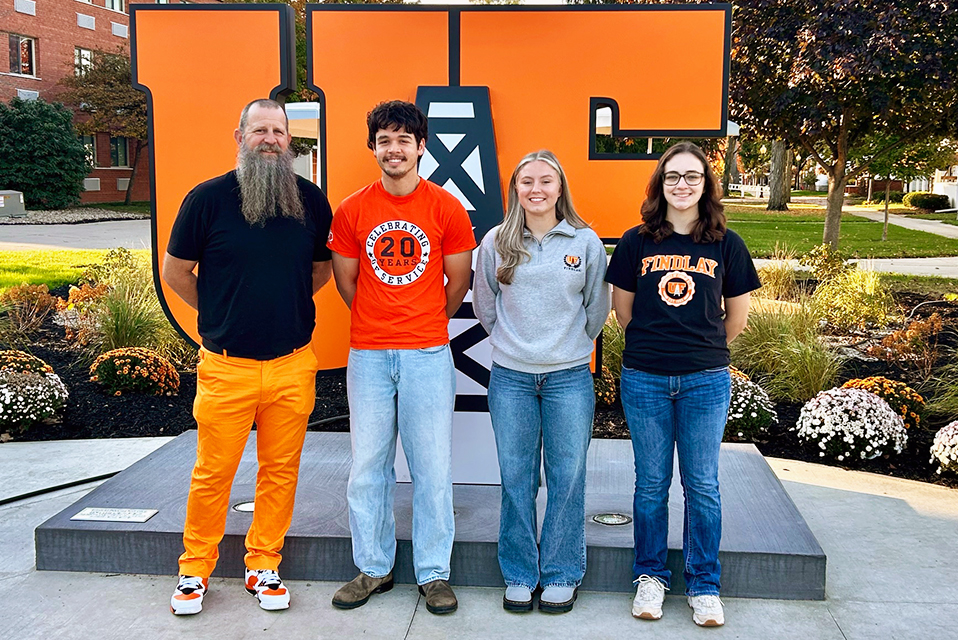
Findlay’s research team is comprised of senior students Allison Diller, Abigail Noss, and Justin Reed, with Justin Rheubert, assistant professor of teaching in biology and co-director of the Honors Program, serving as their mentor.
UF has a history of students participating in national undergraduate research conferences, an honor this year’s team continues. Rheubert said this legacy reflects the caliber of the research conducted by Findlay students, past and present.
“UF is continuously looking for ways to improve and expand its undergraduate research opportunities,” he stated. “Being selected for this opportunity showcases not only the quality of work done by our faculty and students, but that we are in a position to be leaders of undergraduate research and serve as models for other institutions nationwide.”
For the students, the STR Program provides an opportunity to build on experiences that have shaped their college careers while learning to advocate for undergraduate research.
Diller, who is majoring in biology and animal science with a pre-veterinary emphasis, said research allowed her to build meaningful relationships with mentors and peers while developing the confidence to tackle challenging questions.
“Research has become a place where I can contribute ideas, learn from outcomes, and recognize my own potential as someone who is not only capable of absorbing knowledge but also creating it,” Diller said.
This realization has inspired Diller to show others the value of undergraduate research. She hopes STR will further strengthen how she communicates its importance to audiences beyond the University, such as policymakers and organizations that fund research.
Noss, who is also studying animal science and pre-veterinary medicine, shares the same desire to make research opportunities more accessible to future students. Her experience with research has helped bridge the gap between classroom learning and practical application. Furthermore, it has guided her to develop problem-solving and critical thinking skills through laboratory work and field experiences.
“Undergraduate research has prepared me for my next step towards veterinary school as I am more prepared for hands-on applications and figuring out the ‘why’ to different situations instead of pure memorization,” she said.
Upon participating in STR, Noss wants to pass along the learnings and lessons her research experience has unlocked.
“Honestly, I want to just make a brighter future for the next generation of bright minded people who deserve a chance at finding out what their passions are,” she said.
For Reed, a psychology major, undergraduate research has provided him opportunities to grow as an independent researcher while exploring questions related to behavior and aging. Through designing an independent study, analyzing data, presenting at conferences, and working in a research lab in Germany, Reed has developed skills he plans to carry into graduate study.
His experiences have also reinforced the importance of communicating research beyond the laboratory. Reed sees STR as an opportunity to connect the questions researchers investigate with issues that matter to the broader community.
“I want to learn how those conversations can connect the questions we study in the lab to issues that matter in our communities,” Reed said. “I hope sharing my experience helps others see the value of supporting student research and its potential to make a difference.”
From November 2026 to March 2027, STR participants will have opportunities to learn how to share research with diverse audiences and demonstrate broader impact. Reed said he is excited to discuss his research to people with different backgrounds, which he’ll have a chance to do when the Findlay team travels to Washington D.C. in March for the conclusion of the program. He also noted wanting to discover how other students approach their research and learn from their experiences.
“I hope to leave with new connections and ideas that help me take the next step in my development as a researcher,” Reed shared.
With just shy of 50 teams, the 2026-27 STR cohort represents 39 institutions across 18 states and more than 30 disciplinary areas. Together, the participants bring a wide range of research experiences and perspectives to a program focused on making a civic impact.
“Advocating for research at local, state, and national levels is incredibly important to show the importance of not only creating new knowledge or new works but providing students with career-readiness skills that employers expect of graduates,” Rheubert added.
Pictured above (left to right): Justin Rheubert, Justin Reed, Allison Diller, and Abigail Noss.