





University of Findlay Professor Develops Device to Improve Compression Garment Use
 Austin Arnold
Posted On June 25, 2026
Austin Arnold
Posted On June 25, 2026
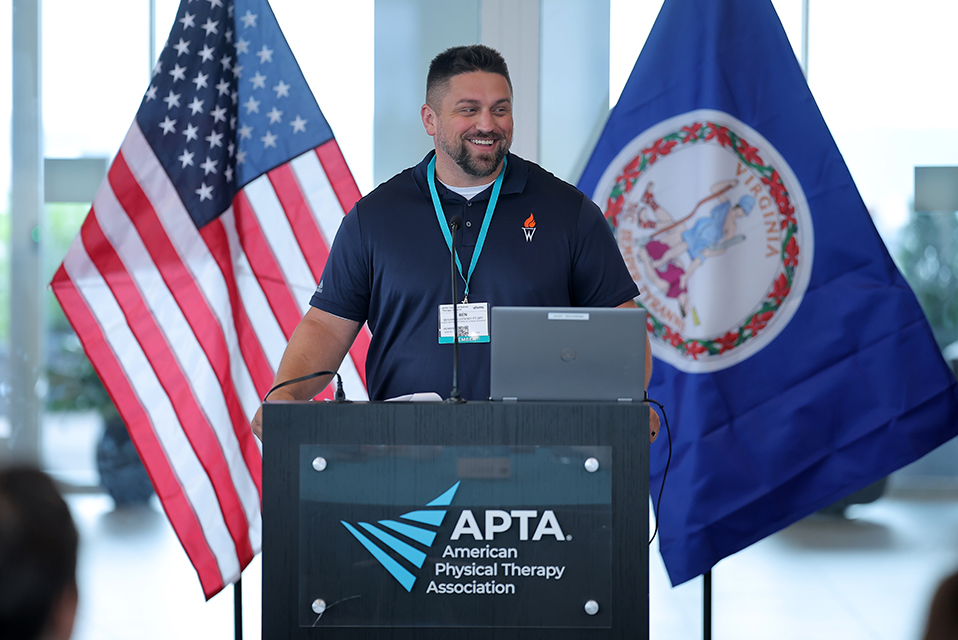
When an invention becomes a reality, it’s often the result of solving an existing problem or challenge. University of Findlay’s Dr. Ben Cooksey, assistant professor of physical therapy, understands this concept personally. Having previously worked in an outpatient therapy office with a lymphedema clinic, Cooksey observed a recurring problem many patients faced and became determined to solve it.
Cooksey, along with two former colleagues, Tim Leo and Nick Sajka, invented CompressOn, a device that helps people put on compression garments while seated. For individuals managing lymphedema, heart failure, and other conditions that cause chronic swelling, those garments are essential for maintaining health and independence.
“Using compression garments is one of the main ways to manage swelling and help people stay as functional as possible, but many of the patients we saw struggled to put their garments on. Existing solutions work for some people, or work well for socks alone, but the people who need help the most don’t have many good options to make this task more manageable,” Cooksey said.
Cooksey and other industry professionals know that compliance with compression garment use is poor. He estimates that only about 25 percent of people prescribed routine compression wear it consistently.
“Those people aren’t instantaneously harmed by that, but their swelling gets worse. They become less active. They develop wounds. They fall. What starts as a theoretically manageable situation deteriorates over time and causes a lot of harm in the long run,” Cooksey explained.
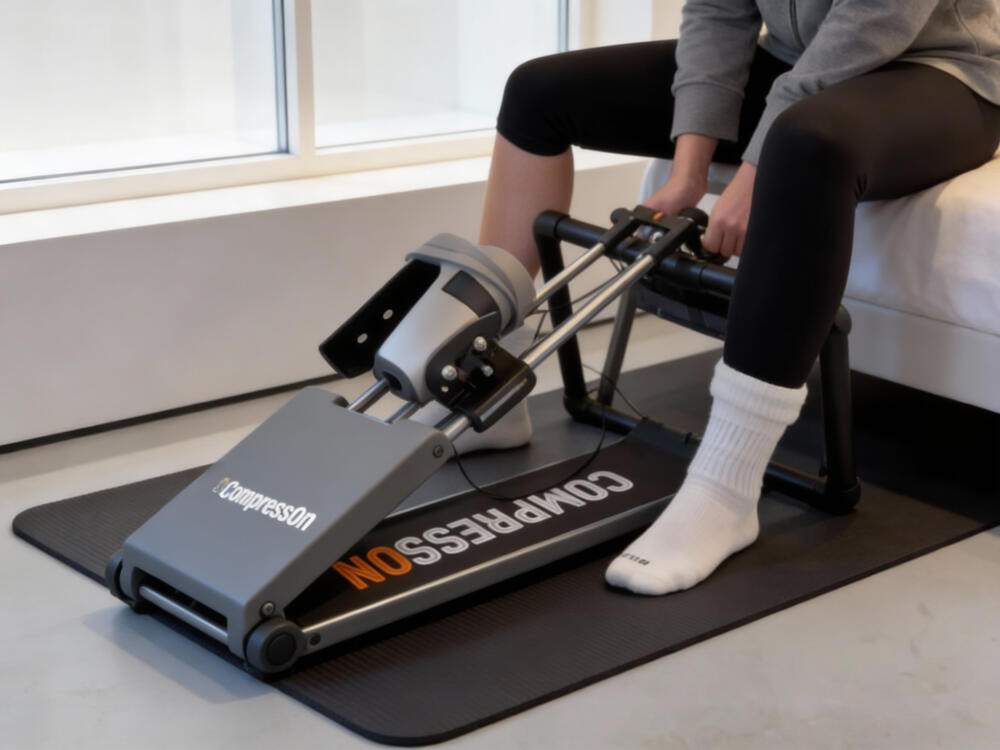
Photo of CompressOn device prototype
After discussing the issue and brainstorming ideas for CompressOn with his old colleagues, Cooksey headed to a hardware store with a few of their sketches in hand. They built the first prototype using wood, a drawer-slider track as a base, a handheld winch designed for jet ski trailers, and vice clamps to demonstrate the concept.
“There was a lot of duct tape involved. That first iteration was sketchy, but it allowed other people to more easily see the idea visually, and that was super valuable,” Cooksey said.
The prototype quickly opened doors. Cooksey and his colleagues connected with MAGNET, a Cleveland-based nonprofit that provides industrial training and entrepreneurial support. There, they participated in what MAGNET calls an “ideation session.”
“We got to sit with a bunch of engineers and industrial designers in a conference room and ‘whiteboard up’ different ideas. It was amazing,” Cooksey recalled.
This experience was only the beginning of sharing CompressOn on a broader scale. The American Physical Therapy Association (APTA) has a specialty group called the Academy of Leadership and Innovation (ALI), which hosts events and offers grants that foster new ideas for clinical technology and patient care processes. ALI also hosts a competition similar to the popular entrepreneurial television series “Shark Tank.”
Cooksey entered CompressOn into the competition, advancing from a semifinal video submission to becoming one of four finalists selected to present live over Zoom.
At the final stage, he found himself competing against advanced motion-capture systems, artificial intelligence applications, and market-ready rehabilitation technologies. In the end, CompressOn was named the winning idea.
“The other finalists had great ideas, and then there was us, talking about how hard it is to put socks on,” Cooksey said jokingly. “The judges were heavy hitters in the industry. One came from the largest durable medical device manufacturer on Earth, while another runs the adaptive technologies research laboratory at Harvard. It was crazy.”
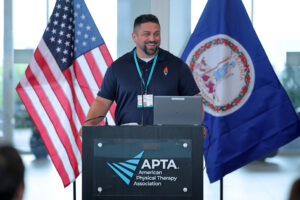
Cooksey continued, “We were honored to be chosen as the winner. I got to present our idea during the Future of Rehab Technology Summit in Washington, D.C., last July, and we also earned a spot in an event called ‘Technapalooza’ at APTA’s major national conference this spring, which was a lot of fun.”
As for next steps, Cooksey said identifying the right strategic partner is critical to bringing the product to market. The recent awarding of the CompressOn patent marks an important milestone, and the team is now focused on progressing through FDA clearance, testing, manufacturing, and marketing. He noted that a professional partner would bring valuable expertise and resources to support those efforts.
“Our hope has always been to get a good enough prototype to tell the story, get the intellectual property protected, and license it to a company that has the know-how and infrastructure to carry things forward,” Cooksey explained. “With that goal in mind, we have been entering pitch competitions to help iterate on the prototype and trying to get in front of as many people who make decisions for medical device companies as possible.”
Cooksey has learned firsthand that a great idea and a patent don’t always lead to instant success. Instead, he sees them as the beginning of a longer journey. Ultimately, his focus is helping people with a specific need rather than generating wealth or notoriety.
“Earning a patent is very much the beginning of a long process. There isn’t a roadmap for the path forward, but there are a lot of resources out there once you start looking for them,” Cooksey said. “If CompressOn can help even a fraction of those people manage their conditions better and live better lives, then every bit of this will have been worth it.”